


The Guide to 2019 App Development: Best Practices and Tips

By Ashley Lipman

 Guide to App Development best practices

There are more than 3.5 billion internet users worldwide which is roughly half the earth’s population. Internet use has been steadily growing over the years but perhaps nothing has expedited global internet penetration as much as the smartphone. Priced much lower, smartphones have smashed the barrier to internet use that was caused by the prohibitive cost of laptops and desktop computers. Little wonder that in 2016, mobile internet users surpassed desktop users for the first time. That number can only be expected to grow not just due to rising penetration in developing countries but also as a result of the growing sophistication of the average smartphone that is gradually transforming into a minicomputer. Even internet users in wealthier countries are spending more time on their smartphones than their computers.

If you are involved with Mobile App Development projects, you will appreciate the rise of the mobile internet and companies’s necessity to have an excellent mobile presence. Hence, this Guide with Best Practices for App Development, is really invaluable for 2019 and beyond.

Here’s a look at some of the most important tips and tricks when building mobile apps in 2019.

1.    Less is More

The move toward simplicity has revolutionized web design over the past few years. As one would expect, this trend is rapidly making its way into the mobile app space. Traditionally, developers would pack in numerous features as well as spectacular interfaces in the hope of leaving a lasting impression on users and standing out from the competition. However, there’s a growing realization that this doesn’t achieve the desired result.

First, when an app has an excessive amount of design elements, the numerous moving parts create multiple areas of potential malfunction. Second, a busy interface can make it difficult for uses to comprehend the app’s logical flow.

To avoid these pitfalls, practice building your apps from the core out. In other words, don’t think about a flashy interface from the get go. Instead, focus on building and perfecting the app’s essential function. Ensure that the processing is seamless, the backend is rock solid (details about this subject on logging would come in handy) and that the results end users expect from inputs fit down to a T.

The bells and whistles are okay to have as long as they do not overshadow or diminish the core purpose of the app.

2.    Minimize End-User Workload

The purpose of an app determines what features are essential and which ones are unnecessary. Unless you are building a banking app or one handling a similarly sensitive process, chances are that you don’t need to incorporate comprehensive controls and security procedures.

A banking app may require session timeouts that force the user to sign in after a period of inactivity. Such controls would however be a needless impediment to the user experience on gaming, messaging and social media apps that are largely used for leisure and to unwind. Keep requested user inputs at the minimum. Don’t ask for information if it isn’t unnecessary.

Make the most of inline validation. That means verifying data validity as the user keys it in. For example, on a new user registration page, the validity of a password should be displayed as the user types it. 

Another practical but often overlooked idea? Autocomplete. When someone downloads your app, they probably already have dozens of apps on their phone that asked them for the same registration information that your app requires. Autocomplete ensures they don’t have to fill in the same data when registering on your app.

3.    Optimize Loading and Processing Speed

App Development best practices

Source: Pixabay.com

If your app loads slowly, you are going to repel many users. Smartphones have experienced giant leaps in processing speed and RAM size just as available internet bandwidth continues its rapid rise worldwide. Nevertheless, this advancement masks the deep variation between devices, platforms and world regions.

Ergo, when developing a mobile app, find ways to create an app that takes this diversity into consideration. As much as possible, your app should load in in under 5 seconds in the majority of environments. In addition, communicate what’s happening to take care of instances where weak connectivity or poor device specs may make faster loading impossible.

For example, show loading progress by percentage that increases at it approaches completion. You could also make it clear that the sluggish speed is due to the user’s poor connection. These measures are vital because if the user opens an app and all they see is a blank screen, they’ll assume it’s frozen and could choose to uninstall it immediately.

If you are unlucky, they’ll even leave a bad rating in the app store. This creates a vicious cycle by steadily diminishing the incentive for new users to download the app in future.

4.    Test, Test and Test Again

App Development best practices

Source: Pixabay.com

Whether you opt for the Waterfall method or choose to go with the Agile approach, testing is an integral part of any software development technique. Yet, a remarkable number of mobile app developers either fail to test their apps or do not give testing the depth of commitment it requires.

Some coders have fallen into the bad habit of making their end users the first beta testers. While this can be an effective way of capturing glitches that escaped developers, it’s possible for one to overly rely on it to identify even the most mundane of app problems. Shoving an untested app into users’ hands can give it a terrible reputation even before it is available to the market in its final form.

Instead, create a robust testing process (automated where possible) that ensures the overwhelming majority of errors are identified well before the app is first made available to some or all end users. Test app functionality, usability, compatibility, versatility, security and everything else that will have an impact on its performance.

And do not stop testing after the app goes live. Networks, devices, platforms and user behavior are always changing so you have to ascertain that your app is still fully functional despite these changes.While the opportunities in the mobile app market are vast, the competition is also incredibly intense. If you are going to stand out from the hundreds of apps that serve a similar purpose to yours, you have to make an effort at making an unforgettable first impression. Design an app that resonates with users and delivers on what it promises. The defining trait of nearly all successful mobile apps is their ability to blend function and aesthetics.

Please subscribe to Virtual Project Consulting not to miss future articles, tips and success stories!

Virtual Project Consulting

Are you on a Time-Critical Project?

By Louise Worsley

Time-critical project

Time-constrained projects arise from four external drivers.

  • Window-of-opportunity—the value of completing the project is severely compromised if delivery is late, for example producing a game for the Christmas market
  • Compliance—meeting a legislated delivery date, for instancebecoming compliant with new privacy laws for personal data
  • End-of-life—increased risk of unprotected catastrophic failure caused by using systems and products after their predicted shelf-life, for example using obsolete switching gear
  • Public commitments—exposing the organization to public ridicule or genuine reputational risk, for example, the opening event of the Olympic Games

Sponsor View

In each of these cases, the significance of meeting the end-date varies depending upon the sponsor’s view of the risk exposure, or loss of benefit, they are prepared to countenance. Missing a legislative compliance date may result in a fine, but the sponsor may decide that this is preferable to the additional costs associated with speeding up the delivery of the project. In a time-constrained project, the project manager must understand the sponsor’s position about the date.

Timeboxing

There is a fifth cause of time-constrained projects. It’s called timeboxing.

Notice the often-useful management effects of rigidly maintained time constraints on projects where some software development methodologies—in the old days DSDM and RAD—and now, Agile approaches – deliberately adopt the imposition of rigid time constraints on the product development process.

In the right circumstances and for the right products, a time-boxed approach works. Its value arises from the impact on what management is obliged to implement to meet its obligations driven by the temporal constraint. Done well, and using the time constraint as a driver for innovation in tasking and resourcing, it is a powerful productivity tool.

Implemented poorly, the time constraint becomes an excuse for de-scoping with disappointing results. There are many circumstances where the imposition of an unnecessary time-constraint leads to trouble, including situations where incurring the associated technical debt is unacceptable. Whatever else it may be, timeboxing is not a panacea for every project.

Is your project really time-constrained?

The truth is that less than 20 percent of projects are genuinely end-date driven. Project end-dates are often not deadlines but more like these:

  • Estimated dates: baseline finish dates that have been calculated based on a task-sequencing tool. These vary over the life of the project as the level of certainty around what is to be delivered and how long the tasks will take, fluctuates.
  • Target dates: a date agreed with the sponsor as a target, but with the understanding that it can be renegotiated should it become necessary to do so. Targets are not constraints—–unless, of course, the sponsor makes them so.

And this is important! The target date may be regarded as a deadline, but it is not treated as a drop-dead end-date. It is not the primary driver for the project.

Strategies for Planning Time-Bound Projects

Where an end-date must be met, the planning process changes. For a start, planning under time constraints always demands more effort in planning, not less. It is essential, therefore, that the project manager engages with the stakeholders so that they become aware of this and in so doing resists the just “get on with it” pressure so often applied by them.

If “time is of the essence” for your project; if you need to bring in your project in tight time-scales, then here are just some of the actions you could and should be considering:

Strategy

“Crash” the schedule by adding resources. Remember, more resources and more tasks mean greater monitoring.

Strategy 1

Identify elapsed time delays, those activities which are not compressible using existing processes.

Strategy 2

Identify delays which may be introduced because of decision-making processes.

Strategy 3

Fast-track the schedule—look for ways of breaking dependencies between activities. Remember, parallel tasks increase resources and risks, so increase monitoring.

Strategy 4

Identify resource skills gaps up front

Strategy 5

Communicate and re-communicate the purpose, objective, CSFs, and value of the project throughout the project’s lifecycle

Strategy 6

Identify foreseeable problems (risks)

Strategy 7

Be prepared for unforeseen problems

Tactics

Working with larger numbers of resources influences the way work is structured, scheduled, and communicated. Remember the bigger the team resources; the less productive each member will be.

Develop new processes, which allow products to be delivered faster. Remember new procedures will create new types of errors, and you won’t have prepared ways to correct them. So test and monitor more.

Ensure clarity on who makes what decisions and stick to it. Factor in decision-making; bring governance closer to the project. Delayed issue resolution can kill your project.

Evaluate and manage the additional risks associated with changing the standard dependency structures. Identify management actions; include in plans. Remember to investigate Start-to-Start with lag times sequencing rather the Finish-to-Start serial sequencing.

Whenever a task demands effort from a specific resource, try to eliminate it—it is a significant risk on time-constrained projects. If not possible, make the attaining and managing of that person as a CSF for the project.

Find ways in meetings and one-on-ones to rehearse the mission of the project with every project member —and in the steering group—and keep checking back with the sponsor that nothing has changed.

Log each risk statement with at least one management action associated with it. Most “fix-on-failure” solutions will cost more in time and money than the other four risk strategies. In time-constrained projects, making good is the least favoured option.

Schedule milestones, even inch pebbles. Only schedule at the level of detail that reflects your level of uncertainty. The less you know, the greater the detail! Remember schedules are the most volatile project document. Expect to change it frequently to account for the unplanned circumstances.

Time-constrained Projects are less complex

Time-constrained projects can be tough on teams; they may involve hard work and lots of overtime. However, our research suggests that managerially, they are often less complex. With an understood, agreed and, most importantly, an immovable constraint—a genuine drop-dead deadline end-date—the compromises that have to be made are clear-cut. Either you meet the end-date—or you fail. It is much easier to manage when the conditions of success are clear!  

Adaptive Planning Techniques

In our research into what makes project managers successful, planning, along with monitoring and control, are the two areas where high-performance project managers spend most of their time. What is also clear from the findings is that the most distinctive characteristic is their ability to use their experience and know-how to adapt their planning approach to meet the specific challenges of the project they were managing.

There is no single approach to planning a project, but neither is project planning a free-for-all. One consistent finding is that the context – the environment within which planning takes place – determines the following:

  • approach that is most appropriate to use
  • which techniques and tools are most suitable and
  • what factors to consider. 

The project-planning environment is itself a product of the set of constraints that bound the project, and these constraints involve much more than time, cost and quality. To plan effectively and appropriately project managers must take into account both the source of the constraint and their relative significance or priority – the hierarchy of constraints.

About the Author:

Louise Worsley, with her husband, Christopher Worsley, are the authors of Adaptive Project Planning, published in February 2019.  This book prepares you for many of the common project planning situations you will meet. It addresses how planning and planning decisions alter, depending on the constraint hierarchy: how resource-constrained planning differs from end-date schedule planning, what is different between cost-constrained plans and time-boxing. It also discusses the challenges of integrating different product development life cycles, for example, Agile and waterfall, into a coherent and appropriate plan.

Readers of Virtual Project Consulting who buy the book now, will receive a discount of 15% – use buying code WOR2019. Click below!

Adaptive Project Planning

13 Ways to Build a Happy and More Productive Workforce

Wellness and how to build an happy and more productive workforce

In today’s demanding world, we need to consider wellness in order to be productive and to stay present, focused and positive in the chaos we’re often confronted with.

We want to strive for well-being so that we can know ourselves better, have more fulfilling relationships, personally and professionally, and reduce stress.

Wellness will lead to happiness and studies like the Harvard Business Review have reported that happy workers are 31% more productive and three times more creative than the rest of the workforce.

Find below 13 ideas to build a happy and consequently, a more productive workforce, with compliments from Wrike.

13 Ways to Build a Happy & More Productive Workforce - by Wrike project management software

Purposeful Planning

By Louise Worsley

If you are going on a journey, it’s a good idea to know where you are going and how to recognize when you’ve got there. Might sound obvious, but many projects fail even that simple test. You really do need to know: 

  1. Purpose of the project: the problem or opportunity it is addressing
  2. Value of the project: why is it worth doing—and to whom?
  3. Objective: what “good looks like”—how to know the project has completed successfully
  4. Scope: what the project is expected to deliver in terms of physical things
  5. Critical success factors (CSFs): what has to be in place for success
  6. Risks: what are the main threats to the success of the project

These are six distinct and different aspects of the project, and failure is much more likely if one or more of them is not known, or, which is more common, they are conflated and confused with each other. The usual culprit is a statement that purports to be an objective, but which is, in fact, a hotchpotch of scope statements, activities, benefits and other outcomes. 

The Six Faces of a Project Plan

Six faces of a project plan

The six aspects of the project plan are like six faces on a beachball.  If you are close into the beachball then you are only going to see three of the faces. In this beachball we see the faces that the sponsor or client is likely to (or at least ought to!) focus on.

And here is our technical specialist or planners view of the beachball.  The tendency to over-focus on some aspects of the plan is an example of the ‘magpie effect’, in which our attention is drawn to those things that matter most to us, often to the exclusion of other views of the world.

Six faces of a project plan

One of the critical roles of project managers is to ensures that each aspect – each face of the beachball gets the attention it requires.  That means ensuring that each of the stakeholders in the project get the space and time to engage in the planning process.

Effective Project Initiation Workshops

One of the biggest decisions that a project manager takes is who to have in the room and be involved in the early stages of initiation.

To get at the problem-objective-value side of the beachball, the first one or two project initiation workshops (PIWs) are for the key stakeholders. They need to engage. The project manager should attend, of course, and possibly other project team members, but they are observers, not contributors.Now is not their time.  Too often we see projects falter as technical specialists drive these early workshops into discussions about solutions – what we can and can’t do – rather than what is wanted and valued.

It is quite likely you will find that despite the best efforts of a facilitator, client stakeholders will drift off into discussing solutions, their preferences, and even how to run the project! All of which is fine and should be recorded, however, the focus of these workshops is the outcomes; a domain wholly owned by the stakeholders. Its purpose is to determine what the project has to achieve. It’s not that other comments and observations will be ignored; necessarily. Such comments by stakeholders maybe fundamental success criteria for the emerging project. So, all ideas should be captured in the appropriate place around the beachball. These will be for discussion and review later.

The process of establishing answers to the three questions posed: ‘Why do it?’, ‘Why is it valuable, and to whom?’, and ‘What does success look like?’ may take several iterations before everybody is happy with the wording. We remember, with some delight, going through this process for a project in Ireland–it was the changeover to the Euro currency in a large bank. After a particularly tense workshop the sponsor, a senior manager in the bank commented, “To be sure, this clarity is a terrible thing.” We like to think he meant it in a good way!

Maintaining the plan-to-execution link

link between plan and execution

Now we have an agreement on the six faces of the project plan. What the world is to be like at the end of the project is understood, and why it is important to succeed, as well as what it is worth and to whom. In most cases, the basis for the solution is also agreed. All there is left to do, is to ensure that the money and effort expended, is structured, sequenced, and demonstrably connected back to the desired outcomes.   

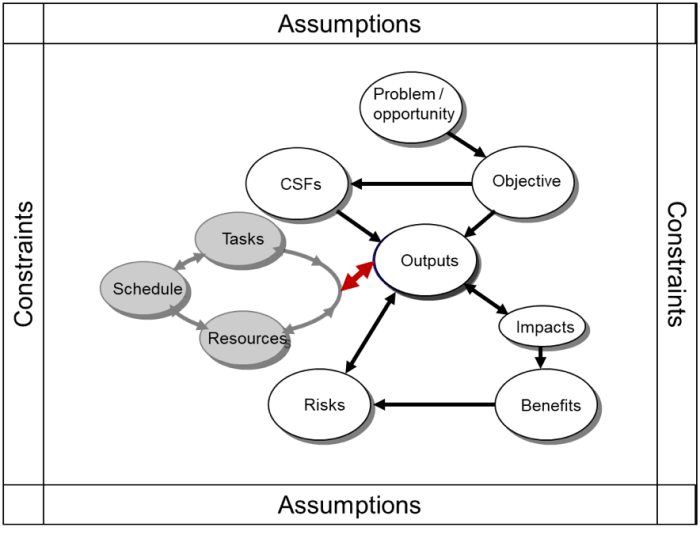
The next stage is to work out how to provide the outputs, what tasks to perform, by whom, and in what order.  Now the project managers will be very much focused on another group of stakeholders – those involved in the delivery of the solution.  But how to make sure that these agendas, this effort remains connected to achieving the stakeholder-required outcomes.

Connecting the ideas and actions, translating the vision of the stakeholders to the mundane actions of a project is the fundamental purpose of project management. And it is a common source of project failure. To address this, CITI, a UK based Consulting Service, developed the CITI Mission Model™. It is used to capture the six perspectives – the six sides of the beachball, and then links them through a ‘bridge’ to the tasks, resources and schedule of an executing project. Maintaining the bridge is the real role of all the project governance structures.

About the author:

Louise Worsley

Louise Worsley, with her husband, Christopher Worsley, are the authors of “The Lost Art of Planning Projects”, published in February 2019Planning to good purpose – planning how to manage successful projects in terms of delivering to the stakeholders’ expectations, is the subject of the book. Based on case studies, it analyses how best to plan under different situations, when and how to plan a project, when you have to use programme planning, and what the role of a portfolio manager really is.  

Readers of Virtual Project Consulting, click below!

The Lost Art of Planning Projects


Innovation through projects

Innovation through Projects

Innovation Through Projects

By Linky van der Merwe

Innovation can mean different things, like a change made to an existing product, idea, or field. It can also be described as the process of translating an idea or invention into a product or service that creates value and for which customers will pay. Being innovative does not only mean inventing. Innovation can mean changing your business model and adapting to changes in your environment to deliver better products or services. Take the project from Google, for example, which delivered Google translator that translates to 100 different languages.

In this article we look at certain traits that innovative people seem to share, how projects are used for innovation, how to measure the outcomes and lastly some examples of innovative projects.

Traits of Innovative People

According to an article in Fast Company, “7 Habits of Innovative Thinkers”, emotional intelligence plays a big role in innovative thinking. People can all become more innovative and creative by developing the traits that innovative people share. Harvey Deutschendorf explains that some of the emotional intelligence-related attributes that innovative people share, are as follows.

  1. Emotional intelligent people have their egos under control and are open to other people’s ideas. They don’t think their ideas are always the best. As a result of their openness to other ideas, they are able to accumulate a larger source of data from which to draw from.
  2. They are confident, not arrogant and they see failures as temporary setbacks.
  3. They are continually curious about people, concepts, and issues. They’re open to new information always on the lookout for new ideas that can be put into practice. Being avid readers, forever seeking out new ideas, and expanding their knowledge base increases their repertoire of tools for future use
  4. They are good listeners who are adept at processing information that makes them excellent listeners. When someone is speaking, most people are formulating a response in their minds instead of just focusing upon what the person talking is saying. Good listeners are able to focus not only on the words that are being spoken, but are aware of the tone of the words, the body language expressed, and the emotions behind them.
  5. They don’t let their emotions affect their innovation efforts. They don’t have to defend an idea that is proven to be wrong as they’re seeking to advance themselves personally and are looking to advance their ideas. 
  6. They can take direction and are able to give direction.
  7. They show empathy towards co-workers and customers.

Now we understand how important the right character traits are for people to come up with innovative ideas. Let’s have a look at how projects can help with innovation.

Project as a Vehicle for Innovation

Projects are good vehicles for innovation as they can be used to solve real-life problems, bring new possibilities (creativity of entertainment at home), bring together subject matter experts through innovation hubs, or to help with goals towards sustainable development. Innovation is a collaborative process; where people in many fields contribute to the implementation of new ideas. This occurs most often through the execution of a project.

Measure of Success

Since projects are so important for implementing innovation ideas, we must consider how to measure whether the outcome of an innovation project was successful and if it was, how do we determine that.

Dr Harold Kerzner’s offers a helpful explanation of how to define success on innovation projects in his White Paper: “Defining Project Management Success with application to Innovation Project Management Practices”. According to Dr Kerzner:

  • There is no single approach for defining innovation project success or success on any other type of project. There must be multiple measures using the right timing.
  • Projects can appear to be successful once the deliverables or outcomes are completed, but real success may occur later when the desired business value is achieved over the longer term.
  • He acknowledges that effective project management practices are contributors to success and therefore must undergo continuous improvements.

Real world examples of Innovation Projects

In the 1990’s after a drop in sales, Lego changed their strategy to focus on the consumer by linking both business and creativity. In order to innovate new Lego sets, LEGO started “Lego Ideas”, an initiative based on a co-create open innovation model. In this online website, LEGO consumers can design their own LEGO sets either using LEGO bricks or computer 3D applications. Users then discuss the idea and vote for it, once the idea reaches a targeted vote, LEGO can consider it as a new product with giving a small part of the revenues to the creator of the set. This model contributes putting the consumer in the heart of the innovation process and help the team to target sets that can achieve success based on the LEGO Ideas votes and comments.

Coke followed a similar open innovation model through a product called ‘Freestyle dispenser machine’. It allows users to mix their own flavors and suggest a new flavor for Coca-Cola products. The new product records the consumer flavor so they can get it from other Freestyle machines using the Coca-Cola mobile application. With the open innovation model putting the consumers in the heart of the production process, the company uses the suggested flavors as part the external ideas that can be evaluated and processed as a new product line.

Managing Innovation Projects

There is no doubt that project managers need to create environments where innovative new ideas are created and implemented. Also visit this video explaining what will enable innovation through projects.

To create the context that is conducive for innovation, we need to understand traits that innovative people share and how to define success and measure the outcomes of innovation projects. This will help to differentiate you as a project manager who can take on that strategic innovation project that your company wants to embark on.

Virtual Project Consulting

Please subscribe to Virtual Project Consulting not to miss future articles, tips and success stories!

A-Z Glossary of Online Marketing Terms for Busy Project Professionals

Online Marketing terms explained

Most organisations have websites and some have an e-commerce presence where they sell their products online. In addition, there are many consulting agencies providing these type of web services to customers. Regardless whether you are doing projects in the e-commerce space for your own organisation or for customers, you need to have a solid understanding of Online Marketing terms to be of better service to your customers.

Below you will find an Infographic explaining the common Online Marketing concepts, an excellent resource for future reference.

With compliments from Wrike, a project management and time tracking software.

A-Z Glossary of Online Marketing Terms
Virtual Project Consulting

Please subscribe to Virtual Project Consulting not to miss future articles, tips and success stories!

7 Technology Trends in Project Management

By Joseph Harisson

7 Technology Trends for Project Management
7 Technology Trends in 2019

Project management is changing every year as new approaches stem from the new ideas and technologies. Staying on top of your game is becoming harder for Project Professionals without keeping up to speed with the latest technological developments.

Many companies are looking for new ways to improve their development cycles. The technology trends of 2019 can help you make the right decisions about investments, team building, and reorganization. Here’s a collection of viral trends that may make a difference for your business strategy this year.

#1 Artificial Intelligence and Machine Learning

AI meets project management

This trend has been on the lists for the past several years, and is still here in 2019. The potential of these new technologies is so huge, each industry is discovering its abilities in regards to project management solutions. 

AI can help your project management capabilities by making predictions about the tasks completed within certain periods of time, the resources used to get the projects done, and automation of numerous tasks thus optimizing the process, and much more.

In fact, all of the above is just the beginning. As AI and Machine Learning are taking over the tasks we used to designate dozens of people for, project financing is possibly having a bright future. 

#2 In the Clouds

Internal or on-site servers are becoming outdated at the speed of light. Cloud is the trend, and it’s not going anywhere. More and more companies are switching to using project management systems in the cloud. In 2019, anyone who hasn’t done that is likely to feel the pressure and experience profit reduction.

The only industries which may avoid cloud project management solutions, may be those with extreme secrecy factors. Most companies will soon realize how much faster and cheaper the cloud-based systems are for their needs. And SaaS companies will need to focus on  more targeted SEO solutions.

When it comes to cross-company interactions, a cloud is a must-have. The work can be done without providing another company access to the internal solutions. In 2018, the number of cloud project management systems has already exceeded the local systems’ demand. In 2019, the difference will become more obvious.

#3 Advanced Data Analytics and Presentation

In 2019, data analytics requires an upgraded approach with project professional being on the lookout for tools, which can help them analyze data and present it in the right manner to executive management.

While such project management software as Trello and Asana are helping managers present the data and organize the work process, they don’t connect the presentation layer to the real data. In 2019, we can expect a rise of data-rich presentation layers since the need for data and its analytics is growing within the project management context. 

#4 Better Information Gathering

Information gathering tools are expected to be top of the list of technologies employed by project professionals. The specific type of accurate market research acquired in a short timeframe can put the company ahead of the competition (with the right analytics, of course).

Cloud-based software which tracks the team progress and allows interactions isn’t enough anymore. In 2019, we’ll be looking at technology constantly updating and adapting itself to the market’s changes. Data is always changing. It’s important to track the changes and avoid outdated and ineffective information. 

#5 More Workflow Automation Tools

With AI and Machine Learning helping the teams optimize the workflow, the desire for automation processes is on the rise. Workflow automation tools are expected to be in high demand in 2019. Freeing team members from the routine tasks is vital for project management needs since it’s becoming harder to find the right staff. 

The demand for project managers will likely exceed the “supply”, thus making automation tools a necessary solution. Older and experienced project managers are retiring while new employees are lacking experience. When looking for workflow automation software, it’s highly important to check if it’s adaptable to market changes. 

#6 Going Virtual

With the rise in cloud systems, virtual collaboration is slowly becoming more predominant than physical communication. Online team software systems are expected to suit the requirements of the virtual team and work processes. With that the need for physical offices will decline.

The software designed for connecting team members from all over the world is in high demand. Skype for video conferencing is likely to stay in the past. Many enterprises will be investing in customized teamwork software to simplify the collaboration while cutting many unnecessary costs, such as office rent. 

#7 Mixing Agile and Traditional Project Management

Agile and traditional project management

Cloud-based project management is becoming easier to access. Many businesses are adopting an Agile development framework. Research has shown that the Agile method improves employee communication, allowing the teams to inspect and adapt to changes faster and easier. Agile has a high ROI for small and medium-sized teams. 

In 2019, enterprises are likely to adopt Agile faster than small businesses. With the appearance of workflow automation software, Agile is becoming more useful for teams of different sizes. 

Modern technologies will help companies adopt hybrid PM methods (mixing Agile and Traditional approaches) to complete projects depending on the context. 

Final Thoughts 

Some of the most common reasons why many projects fail, are poor time management, lack of resources, the project complexity, and absence of specialists. The new technologies are helping project managers solve the majority of the above-mentioned problems.

If you manage to stay ahead of the trends and improve your project management skills while keeping the ever-changing industry demands in mind, you are likely to succeed in 2019.

If you’re still deciding on the best project management software to use, visit this All Project Management Reviews site.


About the Author:

Josh Harisson has 10 years of experience in IT industry as a web developer and cloud computing expert researching extensively for techendo.com. He frequently writes about IT and branding efforts. In his free time, you will often find him taking a walk, or playing video games.


Virtual Project Consulting

Please subscribe to Virtual Project Consulting not to miss future articles, tips and success stories!

Key Project Management Skills Needed for the Future?

Key Project Management skills for the future

By Linky van der Merwe

This article explores two major trends that we observe and attempts to understand what impact these trends will have on the skills of project management practitioners in order to position ourselves better for the future.

“We are looking at a future in project management where the definition of success is determined by the creation of business value. There will be continuous scope changes and customer involvement will be mandatory.” says Dr Harold Kerzner, Executive Director for Project Management for the International Institute for Learning. “Project staffing is now all about capacity planning and resource management. The metrics of the future will have to track tangible as well as intangible elements.”

Future of Project Management 

According to Dr Harold Kerzner, business metrics will include:

  • Business profitability 
  • Portfolio health
  • Portfolio benefits realization 
  • Portfolio value achieved 
  • Portfolio selection and mix 
  • Resource availability 
  • Capacity utilization 
  • Strategic alignment
  • Business performance

Major Trends

Let’s look at the major trends impacting businesses today and what it means to the future of jobs.

Trend 1: Customer Experience

By 2020 customer experience will become the key brand differentiator above price and products and customers are willing to pay more for a better customer experience.

Trend 2: Digitization

Digitisation

Digitization refers to things like Automation and Artificial Intelligence, the capability to move work offshore and the demands of the customer changing in frequency and complexity.

The impact of digitization to our workforce will mean huge reduction in jobs and big changes in skillsets. More than half of school children in primary school today will work in jobs that don’t exist yet.

The World Economic Forum is forecasting that 75% of businesses will become fully digital by 2020. According to McKinsey, organisations are responding by retraining, hiring and doing a mix between the two.

Impact on the Future of Jobs

The Future of Jobs Report by the World Economic Forum states that the industries which can expect the biggest disruptions, include:

  • Financial Services and Investors
  • Infrastructure
  • Mobility
  • Information & Communication Technology
  • Professional Services
  • Energy
  • Consumer
  • Health
  • Media, Entertainment and Information

The skills that are in decline can be summarized as:

  • Project Management administrative and tactical skills
  • Data collection and data analysis
  • Predictable work and repetitive tasks

By 2020 skills will need to transition to:

  1. Complex problem solving
  2. Critical thinking
  3. Creativity
  4. People management
  5. Coordinating with others
  6. Emotional Intelligence
  7. Judgement and decision making
  8. Service orientation
  9. Negotiation
  10. Cognitive flexibility

Future Project Management Skills

PMI talent-triangle

For the past few years the Project Management Institute’s (PMI) emphasis on skills has changed to include a combination of technical, leadership, and strategic and business management expertise. The definition of each skill can be explained as follow.

  • Technical project management: Knowledge, skills and behaviors related to specific domains of Project, Program and Portfolio Management.
  • Leadership: Knowledge, skills and behaviors specific to leadership-oriented, cross-cutting skills that help an organization achieve its business goals.
  • Strategic and business management: Knowledge of and expertise in the industry or organization that enhances performance and better delivers business outcomes.

The Strategic Execution Framework

Strategic Execution Framework

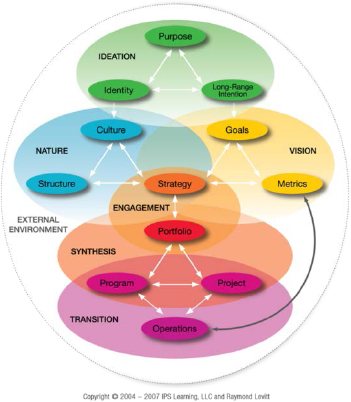
Stanford University has developed a White Paper called The Strategic Execution Framework to help companies stay on track, aligning projects with key initiatives to achieve desired outcomes. It is based on the concept that the building blocks for strategic execution are projects, put in place alongside regular operations to achieve specific goals.


The framework consists of six domains easily remembered by the mnemonic: INVEST

The domains include: 

Ideationis your company’s understanding of what it is and how it appears in the world, expressed through its purpose, identi ty and long-range intention.

Nature creates the conditions for strategic execution. It embodies the culture and structure within which, you operate.

Visionincludes the goals, metrics and strategy that form the foundation for your business.

Engagement connects the enterprise strategy to IT project portfolio investments and clearly demonstrates that your company is funding the right IT projects to further its strategy.

Synthesisis where engagement meets execution, ensuring you’re successfully executing IT projects and programs in alignment with the IT portfolio as well as the enterprise’s overarching strategies.

Transitionis the ultimate measure of success, where you move the results of IT project-based work into the mainstream of operations.

Each of the domains presents opportunities for improvement. The framework helps you identify disconnects and barriers to successful strategic execution and it provides a common language and way of understanding how businesses successfully execute, innovate, change, and grow. You can assess your organization within this context and make necessary adjustments to create a foundation for balanced strategic execution.

Skills Gap in the Digital Era

A Price Waterhouse Coopers Report, based on a survey among 1300 CEO’s, indicated problem solving as the most sought after skill, then leadership, adaptability, creativity and innovation, STEM skills, risk management and digital skills.

Considering the survey results, the skills that Project Professionals seemingly need to develop the most are:

  1. business acumen 
  2. leadership skills
  3. versatility 
  4. technology skills 
  5. executive communications 
  6. application of emotional intelligence attributes.

Continuous Learning

Considering how much growth and development is required to close the skills gaps, there are many ways to learn. You can learn by doing (on the job, stretch assignments), learn from others (mentors, shadowing) and finally formal learning, like a degree.

Also refer to this excellent research article by Louise Worsley called: Be a Project Management Professional Learner, providing a break-down of The Future Work Skills 2020 Report.

PM Skills Development Action Plan

Here are some recommendations for you in 2019 to position yourself as a Project Professional in 2020 and beyond.

  1. Develop an action plan
  2. Keep reading to stay on top of industry trends
  3. Grow others around you
  4. Take every opportunity to demonstrate leadership
  5. Be aware of culture as an enabler for project success
  6. Build diverse teams
  7. Always focus on your customers

Please subscribe to Virtual Project Consulting not to miss future articles, tips and success stories!

Virtual Project Consulting

Sources

  1. The future skillset needs for Project and Program Management by John Daly, a PMI Organisational Agility Conference 2018 presentation
  2. Future of Project Management by Harold Kerzner 
  3. The Future of Jobs Report by the World Economic Forum, Forrester, Gartner, Accenture, Hay Group, 2020 Workforce
  4. Customers 2020: A Progress Report by Walker Customer Experience Consulting, 2017
  5. White Paper: The Strategic Execution Framework by Stanford University, developed by IPS Learning, LLC and Raymond Levitt and used in the Stanford Advanced Project Management Program.

Is Your Team the Focal Point of Your Project?

Software review by Tzvi Zucker from Proggio

Poggio

Every project manager knows that clarity is paramount for project management. The more the team understands their roles, tasks, and the project as a whole, the higher the chances of success. But many project management tools available are either based off Gantt charts, or Kanban boards – and neither of those are an all-in-one package. Gantt charts sacrifice clarity, and agility. Kanban boards sacrifice timeline planning and project visualization. Proggio is the first tool that gives you something better – the Projectmap.

The Projectmap is exactly that – a map of your project, that can be understood at a glance by anybody. Instant clarity – show someone a Projectmap, and immediately they know exactly what the project is about, who’s doing what, when, and even how. 

Proggio's Projectmap

Visual Project Management Software 

Proggio project management softwarewas founded in 2016 and built around the success principles of leadership, team dynamics, communication, collaboration and momentum.

Proggio boasts customers like Sodastream, McKinsey, Decathlon, and Verifone and its online project management software is a favourite for teams of all sizes, and sectors – from non-profits like World Anti Doping Agency to biotech leaders like MySugr to industry titans like SK Telecom, everyone loves Proggio due to the clarity it provides.

The Team as the Focal Point of the Project

Proggio makes a small change in its approach to project management, with a world of a difference. Project management tools are task-based. Your typical Gantt chart lists tasks along the left hand side of the chart. Kanban card sorting systems are built by task. Proggio puts the team heart and center in your project planning and management – in today’s business environment, it isn’t just about what there is to do, it is increasingly important to know who is doing it. 

With “flow to work,” SAFe, and agile teams, being able to plan around the team, rather than the tasks, is a tremendous asset. A timeline of tasks is inefficient – but a timeline OF tasks can be a revolution!

Real Time Project Management Tool

Proggio is designed with the project team in mind. A fully featured, cloud-based, online project management tool, Proggio can be used by your team whether they are in the same room or on 7 different continents. All work is seen in real time, shared in real time, and updated in real time. When Kevin finishes the webinar? You’ll see it updated on your Projectmap. When Gina marks her task as “done”, you’ll see that on the Projectmap, too.

Every team member, and every view in Proggio, is actually the same data set – each person on the project is actually interacting with the project, itself. Always. 

Features and Ease of Use

The interface is clean, modern, and straightforward – the buttons are where you intuitively expect them to be. Within days, you can be using Proggio as if you’ve used it for years.

Proggio comes with some exceptional features that makes it special! 

Plan vs Actual:Every project has delays, or schedule changes. How do you track them? With a Gantt chart, tracking even a few changes becomes a Herculean task. With Proggio, it literally takes just a few clicks.

Project Plan

All you need to do is set a reference point, and whenever you want to track changes, a click of the mouse will bring up your reference point saved in the Projectmap to compare to the current plan. You can set multiple reference points! Tracking your plan vs. actual project has never been simpler.

Print Project Plan: Ever try printing a Gantt chart? It will take reams of paper, or you’ll have to shrink it to a size where it’s illegible. Thanks to the Projectmap, you can easily generate screenshots of your project plan that you can share with anybody. There’s a handy “screenshot” button at the bottom of your Projectmap interface, and you can use it anytime.

JIRA Integration:Proggio boasts a full integration with JIRA, which when used properly will end the software development silo and increase visibility across the organization. JIRA Project management doesn’t have to be a contradiction!

Proggio and JIRA integration

The JIRA Listener tool lets you pull data from JIRA into activity boxes on the Projectmap – you can track progress in JIRA without ever entering the platform! If you’re using Proggio for enterprise-wide planning and collaboration, you no longer need to silo software development teams and run after them for progress reports. 

Finally a Task Management Tool Serving the Team

We all know the hidden inefficiency in project management tools: the data within is only as good as the data your team puts in. And guess what? Most of the time, your team hates your project management tool and don’t want to spend additional time on it. 

Think about the features you love in your project management software: budget tracking? Your team doesn’t care about that. Gantt chart? Your team doesn’t look at those, and doesn’t understand them to begin with. Resource loading? Is that a tool for the team, or for you?

Your team spends their day looking at the task management interface of the program, and that is the reason they hate most project management tools. They’re being asked to use a tool that was not designed with them in mind, and offers them nothing in their work.

Proggio Backlog

Proggio, however, was designed with the team in mind. The task management tools are built to make the team’s life easier, starting with multiple task management views customizable by each team member. The Projectmap is designed to impart clarity to the entire project team. The collaboration tools are built to give the project momentum towards successful delivery. Proggio is all about the team – and the team can tell.

Subscription and Pricing

Proggio offers three subscription plans: 

Starter:Perfect for small teams, the starter package is only $8 per user per month when billed annually. This package allows 3 ongoing projects and comes with 200MB of storage. There is a minimum of 3 users for this account.

Business:The business plan is only $15 per user per month when billed annually, and allows for 25 ongoing projects, 5 viewers, and 5GB of storage. There is a minimum of 3 users for this account.

Enterprise:The Enterprise plan is unlimited – unlimited projects, unlimited storage, and unlimited viewers. Pricing is available upon request.

What is Cognitive Computing

What is Cognitive Computing exactly?

The purpose of this article is to help Project Professionals better understand the meaning of Cognitive Computing and how it’s disrupting business today.

CC describes technology platforms that, broadly speaking, are based on the scientific disciplines of artificial intelligence and signal processing. These platforms encompass machine learning , reasoning , natural language processing , speech recognition and vision (object recognition), human–computer interaction , dialog and narrative generation, among others

Wikipedia definition of Cognitive Computing (CC)

Cognitive computing makes it possible to process data much faster than humans according to research done by Ohio University. If you allow cognitive computing to transform your business, there are certain principles to adhere to, factors to consider for adoption and ways to integrate it into business.

Principles

Humans and computers are now interacting. In business, robots could help professionals as follows:

  • identify and avoid bias,
  • make well-informed decisions,
  • increase the speed and consistency of decision-making.

According to IBM, Artificial Intelligence (AI) should serve a distinct purpose. This purpose, whether it’s used in systems, products, or services, must always be under human control as AI exists to assist humans, not replace them.

A layer of transparency is required. For AI to work, business leaders need to trust the results. This means there must always be clear answers to AI usage, the data the AI handles, and AI is protecting the data and its insights.

Worker skills need to be enhanced. AI doesn’t work without humans, so business leaders need to support them by ensuring workers have proper training to work with AI in a safe, secure, and efficient manner.

Businesses using cognitive computing will likely have to create or be subject to various policies. This can be viewed as an extension of policies around data and privacy, which are continually evolving. In this case, proactively preparing policies could help combat fear, uncertainty, and doubt.

Adoption

IBM offers some ideas for adopting Cognitive Computing.

  1. Develop a cognitive strategy to determine where AI should fit among products, services, processes, and operations.
  2. Construct a foundation of useable and reliable data and analysis.
  3. Another key strategical component is the use and proper configuration of cloud services.
  4. Businesses must fine-tune their IT systems for cognitive workloads.
  5. Finally, business must make sure the cognitive computing system is secure.

Steps to Integration

An integration approach needs to consider a few things.

  • Businesses must firstly determine what opportunities exist to create more engaging and personalized customer experiences.
  • They must also pinpoint specific data that can help them meet objectives but isn’t being leveraged.
  • Then calculate the cost of their organization relating to non-evidence-based decisions.
  • They also need to determine the benefits gained by detecting hidden data patterns.
  • Finally, they need to figure out their organizational expertise skill gap.

Below you will find an Infographic that provides a good summary of Cognitive Computing.

How properly utilizing cognitive computing can allow businesses to use technological advances to increase corporate efficiency

Ohio University


A Reminder of 10 Project Management Best Practices

10 PM best practicesWhen you think of best practice, it can be defined as the most efficient (least amount of effort) and effective (best results) way of accomplishing a task, based on repeatable procedures that have proven themselves over time for large numbers of people. Wikipedia defines best practice as a technique, method, process, activity, incentive, or reward that is believed to be more effective at delivering a particular outcome than any other technique, method, process, etc. when applied to a particular condition or circumstance.

Naturally, in the domain of Project Management many standard practices have evolved into best practices over time. It is after all about developing and following a standard way of doing things!

In the Infographic below, you will find a reminder of 10 PM best practices that will help you be more successful on all your projects in a consistent and predictable way, with compliments from Wrike project management softwares.

Don’t Forget These 10 Project Management Best Practices

How to Handle a Project Management Crisis

How to handle a PM crisisThere are many examples of failed projects all over the world. Like the St. Helena airport, built on a island in the vast open Atlantic Ocean, known for it’s volcanic mountain rising 2600 feet above the sea. The reason for the airport’s opening being postponed indefinitely: “too windy for planes to land” (Source: International Project Leadership Academy). They failed to address the risks or to listen to the advice of experts.

Another project disaster and one of the most expensive scandals in modern history in September 2015, the admission that Volkswagen cheated government emission testing. The engineers intentionally designed and installed a so called “defeat device” into the engine’s control computer. The defeat device was programmed to detect when the car was undergoing emissions testing in order to adhere to the testing limits for clean-air standards. The technology needed to comply with the government regulations was available, but was decided against due to high costs and to protect profit margins.

On a smaller scale project disasters happen quite often, even on IT projects, for example when a record number of high defects are logged during a testing phase leading to re-design and expensive re-development work to the point where committed deadlines are missed or almost missed.

In following good Project Risk Management practice, you will always plan risk management upfront, identify all the risks, perform proper risk analysis (qualitative, quantitative), plan risk responses including assigning risks to owners and then control the risks rigorously throughout the project.

Below you will find a good approach for handling crisis on projects in the Infographic brought to you by Wrike free task management tools.

Let us know in the comments what project management crisis you have come across and how it was handled.

How to Handle a Project Management Crisis